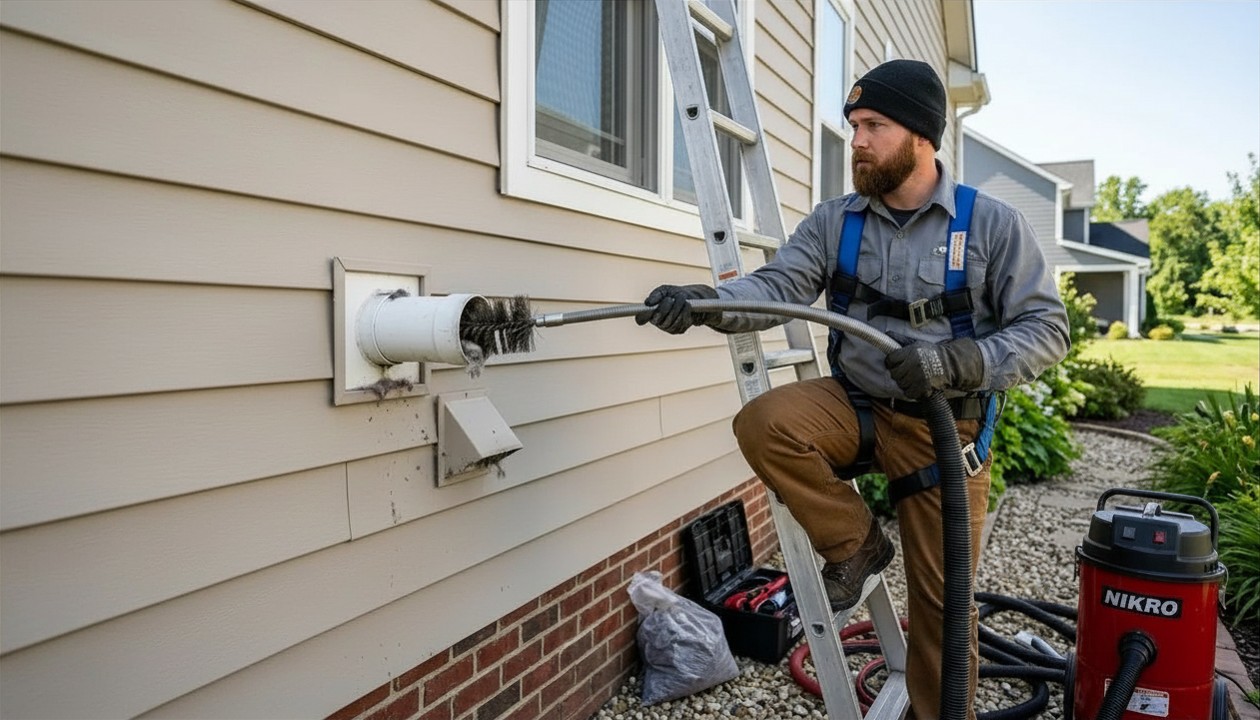
Doctor Vent cleans dryer vents across entire apartment communities in Charleston — every unit, every building, documented with before and after photographs. We work with community managers, regional managers and maintenance supervisors at properties from 50 units to 1,000+.
Apartment Vents in Charleston
Charleston apartments face Lowcountry humidity — lint compaction here is among the fastest in the country. Peninsula properties in historic converted buildings carry retrofit venting; Mount Pleasant and Summerville’s fast-growing garden inventory runs conventional wall terminations on newer construction.
Why Apartment Vents Block Faster
Apartment dryers work harder than any residential appliance — more loads, back-to-back cycles, and residents who never clean the lint screen. A vent that would take three to four years to block in a single-family home can block in 12 to 18 months in a heavily used apartment unit. This is why NFPA 211’s annual inspection requirement matters most in exactly your asset class.
Nationally, failure to clean causes 34% of the estimated 15,970 annual US dryer and washer fires (NFPA). In a multifamily building, a vent fire does not stay in one unit — it travels through duct chases into wall cavities and shared structure.
Built Around Occupied Communities
Cleaning vents in an occupied Charleston community is a logistics exercise as much as a technical one. We agree the schedule with your office, provide notice templates for resident communications, work building by building in a published sequence, handle no-entry units with a documented re-attempt process, and check in with your office daily. Crews are uniformed, badged and background-checked — they are walking into residents’ homes and representing your management company while they do it.
What You Receive
- Full-length cleaning of every vent — dryer connection to exterior termination
- Before and after photographs of every single unit
- Airflow verification at every unit
- Deficiency log — crushed ducts, disconnected runs, foil transitions, failed dampers
- Access exception list — units we could not enter, and when we tried
- Completion certificate referencing NFPA 211 for your compliance file
Per-Unit Pricing
Charleston apartment communities are quoted per unit — typically $18–35 depending on termination type and access. Portfolio rates available for management companies with multiple Charleston-area properties. Satellite quoting returns a firm quote within 24 hours, no site walk needed.
Vendor Credentialed
We maintain compliant profiles in NetVendor, RealPage Vendor Credentialing and VendorCafe — so onboarding takes days, not weeks.
See also: Commercial dryer vent cleaning in Charleston | HOA programmes
Neighborhoods and Submarkets We Serve in Charleston
Our crews work across the entire Charleston metro. If your property is here, we service it:
- Downtown Peninsula
- French Quarter
- South of Broad
- Cannonborough
- Elliotborough
- Wagener Terrace
- West Ashley
- James Island
- Johns Island
- Folly Beach
- Mount Pleasant
- Isle of Palms
- Sullivan’s Island
- Daniel Island
- Summerville
- Goose Creek
- North Charleston
- Ladson
Serving the Whole Charleston Metro
Local Conditions That Affect Charleston Dryer Vents
Lowcountry humidity makes lint compaction among the fastest in the country, and hurricane season drives debris into terminations across the peninsula and barrier islands. Salt air corrodes damper components at coastal properties.
Frequently Asked Questions
How much does apartment dryer vent cleaning cost per unit in Charleston?
Typically $18–32 per unit for a community-wide programme. A 240-unit Charleston community budgets roughly $4,320–$7,680. Termination type and access drive where you land. Portfolio rates apply for management companies with several Charleston properties.
How often do Charleston apartment dryer vents need cleaning?
Apartment dryers work harder than any residential appliance — more loads, back-to-back cycles, and residents who never clean the lint screen. Most Charleston communities run a 12–18 months cycle. Lowcountry humidity makes lint compaction here among the fastest in the country. Peninsula properties in converted historic buildings carry retrofit venting; newer suburban stock runs conventional wall terminations on shorter runs.
How do you handle occupied units and resident access?
We agree the schedule with your office, provide resident notice templates, and work building by building in a published sequence. Crews are uniformed, badged and background-checked. No-entry units get a documented second attempt, then an exception list — we never bill for units we did not enter. First-pass access typically exceeds 90%.
How long does each unit take?
Roughly 15–20 minutes for a typical wall termination: access and disconnect, rotary brush the full duct run with concurrent negative-air extraction, clear and inspect the termination, verify airflow, reconnect and photograph. Rooftop and riser units take longer. A crew of two completes 30–40 units a day in an occupied community.
Why do Charleston apartment vents block faster than houses?
Usage. A single-family dryer runs a few loads a week; an apartment dryer runs many more, often back to back. A vent that takes three to four years to block in a house can block in 12–18 months in a heavily used apartment. Nationally, failure to clean causes 34% of the estimated 15,970 annual dryer and washer fires — and in a multifamily building a vent fire travels through shared duct chases into wall cavities and adjacent units.
Is this required by law in South Carolina?
For multifamily, effectively yes. South Carolina enforces the IFC statewide NFPA 211 requires annual inspection and cleaning as necessary. The charleston fire department inspects multifamily occupancies against it.
What documentation does my regional manager receive?
Before and after photographs of every unit, exterior termination photos, an airflow verification summary, a deficiency log with unit locations and photographs, an access exception list, and a completion certificate referencing NFPA 211. Delivered within 48 hours.
Are you credentialed with our vendor compliance platform?
We maintain compliant profiles in NetVendor, RealPage Vendor Credentialing and VendorCafe. Onboarding takes days rather than the usual weeks, and certificates of insurance are issued to your exact additional-insured and waiver-of-subrogation wording.
Why Property Managers Choose Doctor Vent
Doctor Vent LLC was founded in 2011 and has cleaned 18,000+ dryer vents across 3,200+ properties. We are a NADCA member, our supervisors hold Air Systems Cleaning Specialist (ASCS) certification and OSHA 30, and we are an approved vendor in NetVendor, RealPage Vendor Credentialing and VendorCafe. We carry $2M general liability and a $5M umbrella through The Hartford, and issue certificates of insurance to your exact wording, usually the same day.
What a Project Actually Looks Like
A 312-unit garden-style community in Orlando — 18 buildings, nine days, fully occupied. The deficiency log recorded heavy lint accumulation, blocked rooftop exhaust terminations, dust build-up inside supply trunks, multiple disconnected dryer transitions, and poor airflow in upper-floor units.
Airflow improved by approximately 22%. The disconnected transitions mattered most: those units were discharging hot, lint-laden air into the building structure, and the residents had reported nothing, because their dryers appeared to work.